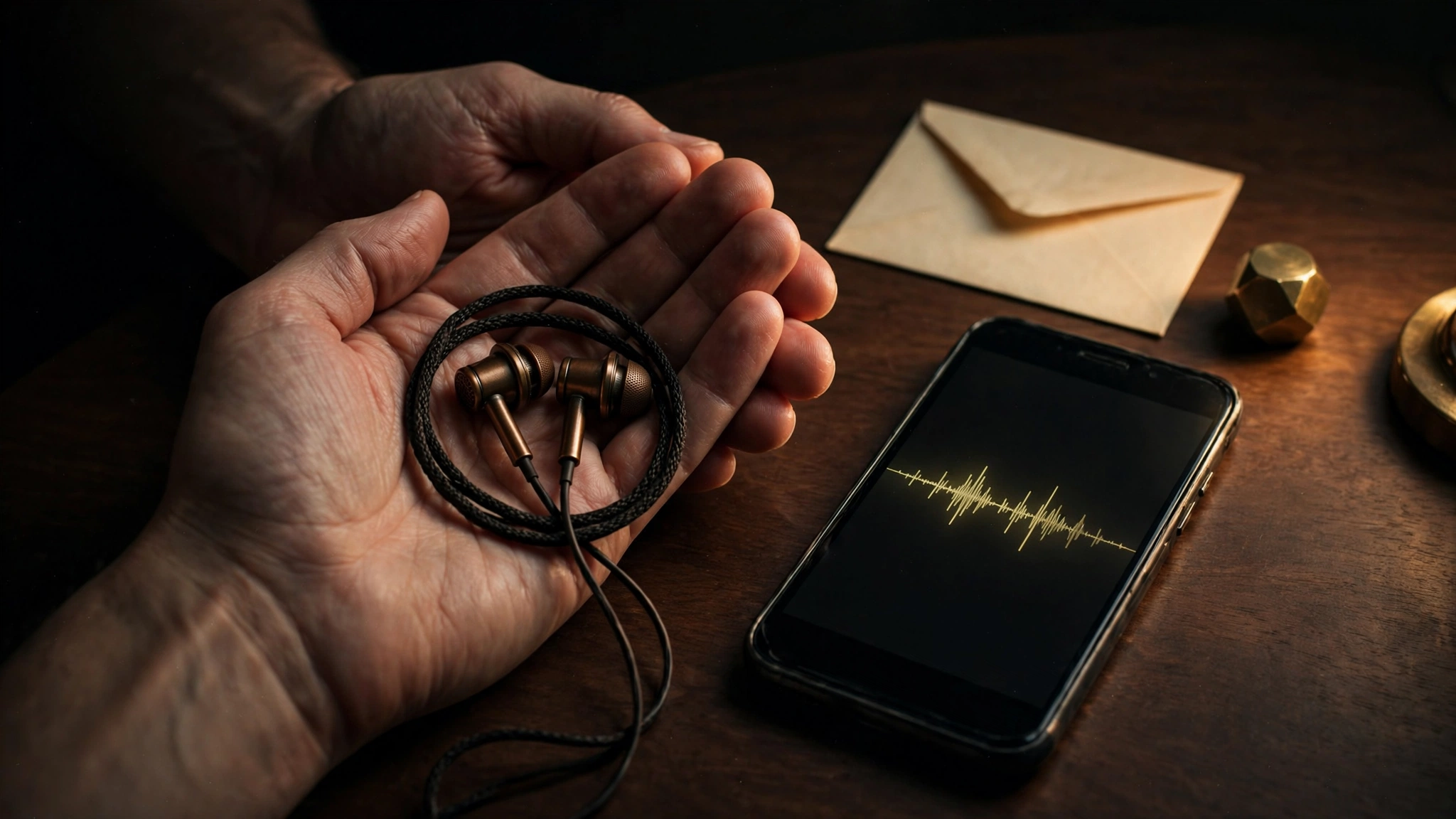
The kitchen table sits empty under a single lamp. Your thumb hovers over a saved voicemail. The house has gone still in a way that feels wrong. You want to press play. You also want to keep the sound from wearing thin. Is voice preservation different from an AI-cloned voice? Yes. Voice preservation keeps the words they actually spoke. An AI-cloned or AI-recreated voice can sound close, then say things they never said.
That pull to hear them again makes sense. When you are aching, you reach for anything that sounds close. There is no shame in that search. You are holding what remains of their presence in digital files you already have saved.
By Andrea B. Denney, Full Legacy Preservation Artist. 17-year caregiver. Twice widowed.
Why do we ache to hear their voice again?
We ache because a voice is one of the few remaining ways a person still feels near. Photographs hold a face. A voice holds breath, cadence, and the small pause before they said your name.
After loss, the silence is not empty. It is shaped like them. You notice it in the kitchen, in the car, in the hour when they used to call. A recording does not bring them back. It lets you keep company with what love left behind.
Caregivers know this in the body. A late-night clip can steady a shaking hand. A laugh on an old video can fill a room that has gone too quiet. The ache is not a flaw in you. It is evidence that the bond did not close when the last conversation did.
Many people wait to press play because the sound is precious and the feeling is heavy. Both can be true at once. Wanting to hear them, and fearing the moment you do, is part of the same love.
Why does an AI-cloned voice feel tempting after loss?
An AI-cloned voice feels tempting because it promises more of them when the files you have feel too few. Demos show a familiar tone singing, reading, or answering a question. When the house is quiet, that promise is hard to ignore.
Wanting that closeness is human. You are not foolish for looking. The heart will try any door that might lead back to their sound. If you have already tried an AI recreation, that choice came from love, not from a lack of care.
The catch is quiet. An AI clone is built to generate new speech from samples. It can fill gaps with patterns. It cannot recover a choice they never made. The closer it sounds, the easier it is to forget that the new sentences were never theirs.
A likeness can soothe for a minute. Then a word lands wrong, a laugh arrives in the wrong place, or a sentence appears that they would never have said. The comfort thins. What you wanted was them, not a skilled imitation wearing their tone.
What is the difference between a convincing imitation and real voice preservation?
Real voice preservation protects the exact words and sounds they left in your saved digital files. An AI clone mimics tone and timbre, then generates speech they did not speak. One is their record. The other is a likeness built after the fact.
A cloned voice, gently put, is a convincing stranger wearing the voice you love.
This is a question of truth, dignity, and consent. They spoke what they spoke. They did not agree to a future script. Voice preservation stays inside the archive they already made, even if that archive is one short message.
Can an AI clone say things they never said?
Yes. AI voice cloning trains on short samples, then produces novel sentences. It can compose greetings, stories, or replies your loved one never spoke. The sound may feel familiar while the words walk into territory they never chose.
That gap matters. They cannot approve a sentence invented after they are gone. A cloned "I love you" may be the sentence you long to hear, and still not be theirs. Voice preservation refuses that trade. No new lines. No fabricated goodbye. Only their voice, as recorded.
Some tools also invite ongoing chat, as if the person were still here to answer. That can blur the line between memory and stand-in. The work of Full Legacy Preservation Artistry is the opposite: keep what is real so you can carry it, not pretend the conversation never ended.
What does a real recorded voice actually carry?
A real recorded voice carries their unfiltered self. Kitchen noise behind a greeting. A hesitation before hard news. The way they said your name when they were tired. A voicemail from the driveway. A phone video where they talk over dinner. Those layers are the person, not a model of the person.
You can hear the room they were in. You can hear whether they were rushing or lingering. You can hear the joke that only your family understands. An imitation can copy pitch. It cannot copy the life that was happening around the words.
Preservation can lift clarity where the file allows it, then organize the moments that matter. The essence stays theirs. The work is to keep what already exists from fading, not to invent a version that can chat on command.
What does the second loss mean for a loved one's voice?
The second loss is the later, quieter loss, when the files that held their voice disappear. Carriers delete. Phones die. Accounts close. A SAVE folder on a lock screen is not a backup. The first loss took the person. The second loss takes the proof that they sounded like themselves.
Verizon often deletes voicemails after 30 days. AT&T often after 14 to 20 days. If a message still lives with a carrier, you can save voicemails before Verizon deletes them, and before AT&T does the same. That clock does not wait for a calmer week.
The second loss also happens in slower ways. A phone upgrade that does not transfer audio. A cloud account that changes policy. A file that will not open five years from now. Without copies in stable formats, their voice can slip away a second time.
This is why voice preservation starts with digital files you already have saved, before the silence takes them. You do not need a perfect archive tonight. You need one protected copy of what still exists, in a place that is not a dying phone.
How does human artistry protect a voice that already exists?
Human artistry listens to the files you already have, cleans them with care, and builds a private heirloom from their real words. It does not invent more of them. At Andrea B. Denney Studios, hands guide the curatorial choices so the voice can outlast a phone, a platform, and a policy change.
The artistry lives in what to keep, how to sequence it, and how to store it so it still plays decades from now. WAV masters are built for later years. MP3s are built for today. Copies live in more than one place. The original file is never treated as disposable.
Does Andrea use AI to clone or recreate a voice?
No. Andrea does not use AI-generated voice cloning, voice recreation, sound replacement, or fabricated words. AI may assist with editing or organization only. The voice itself remains human, based on the person's actual saved digital files.
This is a boundary about truth. Families receive real audio, curated into a private collection. Nothing is sold or shared. Editing tools may help reduce noise or sort a folder. They never generate a sentence. They never replace a voice. They never build a chatbot in someone's name.
Think of it the way fine art photography holds value: the image is of a real person, in a real place, made by human hands. The same standard applies here. Truth over tech. Their voice, not a synthetic stand-in.
What digital files can voice preservation work with?
Voice preservation works with digital files you already have saved and can access. That includes saved carrier or visual voicemail audio, videos where you can hear their voice, saved iPhone or Android voice memos and voice notes, saved or exported Facebook or Messenger audio, and client-provided cloud-drive files. Other digital types can be discussed case by case. They are never promised in advance.
One short file is enough to begin. Messy names still count. If it holds their voice and you already have it, it belongs in the conversation. You do not need two hundred clips to start protecting one.
What files stay outside this work?
This work is for digital files only, that you already have saved. It does not include WhatsApp audio, Alexa or smart-speaker history, forensic recovery from old dead phones, analog-to-digital conversion, tapes, vinyl, cassettes, VHS, or files you cannot already access. There is no extraction from a device or service you cannot open.
Clear limits protect your time and energy. Bring what you have. If you are unsure whether a file fits, that is a reason to review, not a reason to force a file that is not there.
What can you do next if you already have their voice saved?
You can start by protecting what you already have, at your pace. The $19 self-guided Starter Kit helps you find, save, and inventory digital files you already have. You can pause after one file. You can return later. A kitchen-table afternoon is enough for many families. Seven careful minutes can be enough for the first clip.
If you are unsure whether a crackling clip can be saved, a $297 Voice Review of files you already have looks at what you send and maps the next honest step. Upload when you are ready, even late at night. There is no live performance and no calendar to brave.
Deeper restoration belongs to Full Voice Preservation, a done-with-you heirloom of the real voice, with WAV masters built to play in later years and MP3s for today. Restoration is never guaranteed before review. Results depend on the file.
Voice is one pillar of Full Legacy Preservation Artistry, which also includes fine art photography, books, and daily Companion support. You do not have to climb the whole ladder tonight. Learn Andrea B. Denney's story as a 17-year caregiver and twice-widowed Full Legacy Preservation Artist when you want the person behind the work. If you want the four-phase path that holds this care, the Legacy Continuance Method is there when you are ready.
Voice preservation questions families ask before they choose
Is voice preservation the same as AI voice cloning?
No. Voice preservation curates and protects their actual recorded words from digital files you already have saved. AI voice cloning generates new speech from samples. The first keeps their record. The second creates speech they did not speak.
Will Andrea put words in their mouth?
No. Human artistry preserves only what they spoke in your saved files. There is no cloning, no recreation, and no fabricated goodbye. Their voice stays as they left it.
What if I only have one short digital file?
One saved digital file is enough to begin. Start by protecting and inventorying it. If you are unsure what that file can support, a Voice Review can assess it. A brief laugh can still be an heirloom.
What if the recording quality is poor?
Keep the original file. Do not delete it. Gentle editing can lift clarity where the recording allows. Restoration is never promised before the file is reviewed. Authenticity stays first.
Do I have to decide everything tonight?
No. Take the time you need. Saving one file you already have is a complete first step. Larger decisions can wait. Dignity includes pace.
Human hands hold what love left behind. Voice preservation carries their real words forward so you can Move With, Not Move On. There is no pressure and no rush. When you are ready, their voice is still in those files, waiting for care that tells the truth.